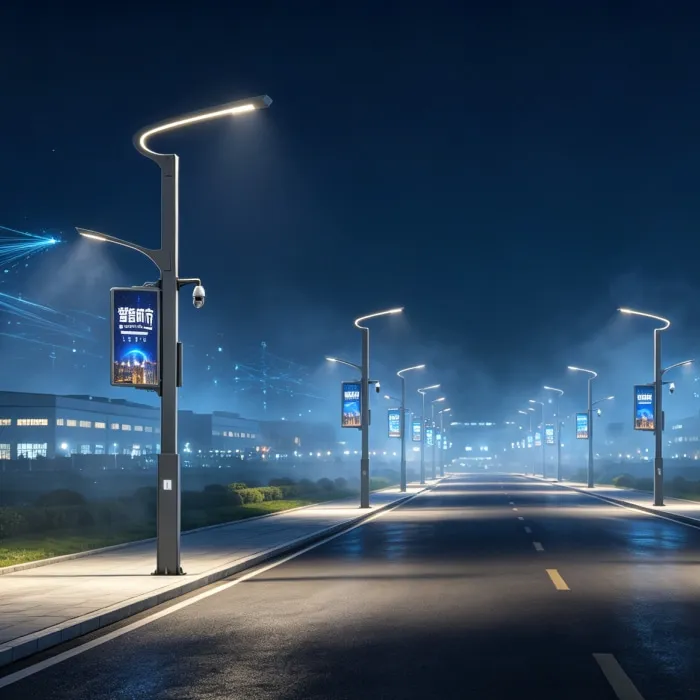
1. Project Background and Requirements Analysis
As the rural revitalization strategy continues to advance, improving rural infrastructure and the living environment has become a key task. However, in many rural areas, night-time road lighting still has long-standing blind spots due to complex terrain, high costs for extending the power grid, and unstable electricity supply. This affects residents’ travel safety and also reduces the vitality of rural night-time economic activities. Solar street lights have become the mainstream choice for rural road lighting because they provide independent power, require no electricity cost, are flexible to install, and are green and low-carbon.
In real-world deployments, traditional solar street lights often suffer from a “heavy construction, light management” problem: fixture failures are discovered late, battery life is short, endurance is insufficient during cloudy or rainy days, maintenance depends on manual inspections, and the equipment status across different towns cannot be uniformly monitored. Therefore, rural solar street light projects should not only focus on “turning lights on,” but should instead build a complete system solution centered on “reliable equipment, smart maintenance, and long-term management.”
This solution uses the “Sanqian Smart” series solar street lights and a smart street lighting management platform as the core. It targets scenarios such as towns, administrative villages, natural villages, and rural connecting roads, and proposes an end-to-end solution path covering planning and design, equipment selection, smart management, and maintenance assurance. The solution also supports overseas deployment in off-grid or weak-grid regions, and has already been successfully implemented in countries such as the Philippines.
2. Design Principles and Basis
The solution follows the basic principles of safety and reliability, economic practicality, smart efficiency, green low-carbon, and ease of maintenance. It mainly references standards including:
- CJJ 45 “Urban Roadway Lighting Design Standard”
- GB/T 24460 “General Technical Specification for Solar Photovoltaic Lighting Devices”
- GB/T 24907 “Performance Requirements for LED Lamps for Roadway Lighting”
- “Overall Requirements for Smart City Smart Multi-Functional Pole Systems” (and related standards)
It also provides customized design based on rural road classifications, road width, pedestrian/vehicle traffic flow, and local sunlight conditions.
Key design indicators include:
- Average illuminance for general rural branch roads: not less than 8–10 lx
- Average illuminance for main connecting roads: not less than 15 lx
- Uniformity: not less than 0.3–0.4
- The system should ensure continuous normal lighting during 3–5 consecutive cloudy/rainy days (for special regions, extendable to 6 days)
- Full fixture lifetime: not less than 10 years
- Lithium battery cycle life: not less than 1500 cycles
- The smart management platform should support an equipment online rate of not less than 95%
3. Overall System Architecture
The system adopts a four-layer “Edge–Network–Cloud” architecture to form a complete rural lighting Internet of Things (IoT) ecosystem.
Perception & Execution Layer
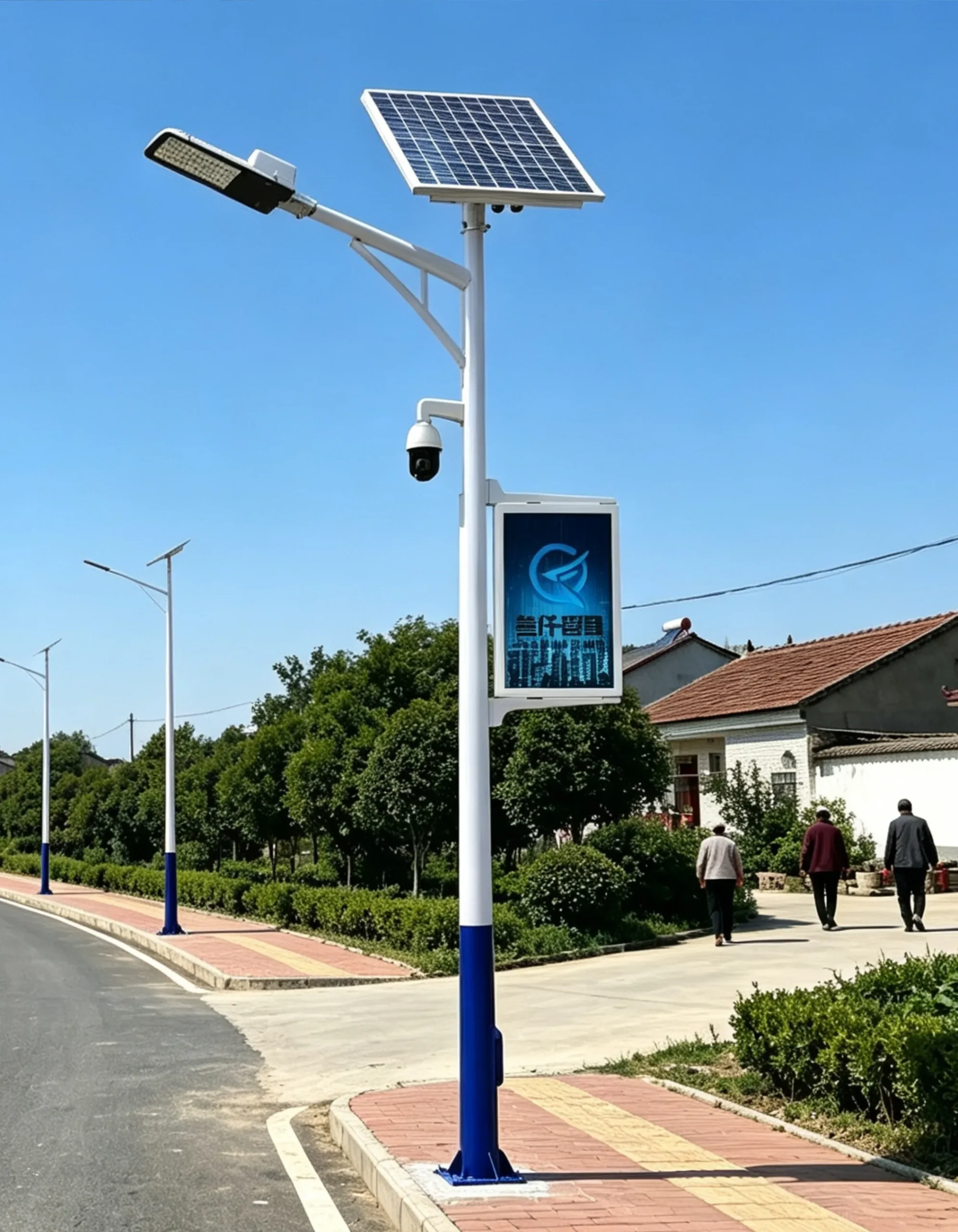
This layer consists of solar street light terminals installed along roads. Each set of street lights integrates high-efficiency photovoltaic modules, lithium iron phosphate batteries, LED light sources, smart controllers, communication modules, and sensors. The terminals are responsible for energy harvesting, storage, lighting execution, and status reporting.
Network Transmission Layer
Based on rural communication conditions, it supports multiple communication methods such as NB-IoT, 4G Cat.1, and LoRa. For remote areas with weak signals or no public network, a LoRa self-organizing network gateway can be used to aggregate data and then send it to the cloud. In some cases, satellite backhaul can also be used to ensure all devices are manageable and controllable.
Platform Layer
At the core is the “Sanqian Smart Cloud Platform”, which provides services such as device onboarding, data storage, rule engines, alarm management, energy consumption analysis, and GIS mapping. It supports unified management across multiple towns, multiple projects, and even cross-country deployments.
Application Layer
This layer provides Web and mobile applications for county-level management departments, town maintenance personnel, village responsible persons, and overseas project operation teams, enabling “one screen to view the full coverage, one network to manage all lights.”
4. Core Equipment Selection and Configuration
1) Solar Modules
Use high-efficiency monocrystalline silicon photovoltaic modules with conversion efficiency of not less than 21%. Module power is calculated based on the light source power and daily sunshine hours. Typical selections are:
- Rural branch roads: 60W–100W
- Main roads: 120W–200W
- For low-latitude or high-humidity areas, module power can be increased appropriately.
Modules use tempered-glass encapsulation with hail resistance and wind-pressure resistance. Mounting angles can be adjusted from 15° to 45° according to local latitude to improve winter or rainy-season power generation efficiency.
2) Energy Storage Batteries
Use lithium iron phosphate batteries with an operating temperature range of -20°C to 60°C, and with protections for overcharge, over-discharge, overcurrent, and short circuit. Battery capacity is configured to meet continuous normal lighting for 3–5 cloudy/rainy days (extendable to 6 days for special regions). Typical configurations are 12.8V/30Ah–60Ah. Batteries use a detachable structure design to facilitate later replacement and avoid scrapping the entire fixture. For coastal or high-salt-fog areas, the battery compartment uses a fully sealed anti-salt-fog design.
3) LED Light Sources
Use high-efficiency LED modules with luminous efficacy not less than 160 lm/W. Recommended color temperature is 4000K neutral white, and the color rendering index Ra ≥ 70. Fixture protection rating is not less than IP65 (for coastal or high-humidity areas, recommend IP66). Impact resistance should be IK08 or higher. The light source uses an intelligent constant-current driver that supports 0–100% stepless dimming, providing a foundation for smart energy-saving strategies.
4) Smart Controllers and Communication Modules
The “Sanqian Smart” solar street light integrates an all-in-one smart controller, including MPPT efficient charging management, multi-time-segment dimming, energy metering, fault self-diagnosis, remote communication, and more. The controller supports automatic on/off based on sunrise and sunset, and can dynamically adjust brightness according to real-time battery energy to avoid deep discharge that accelerates battery aging. Communication modules support NB-IoT, 4G Cat.1, LoRa, and satellite backhaul, adapting to different network environments.
5) Poles and Foundations
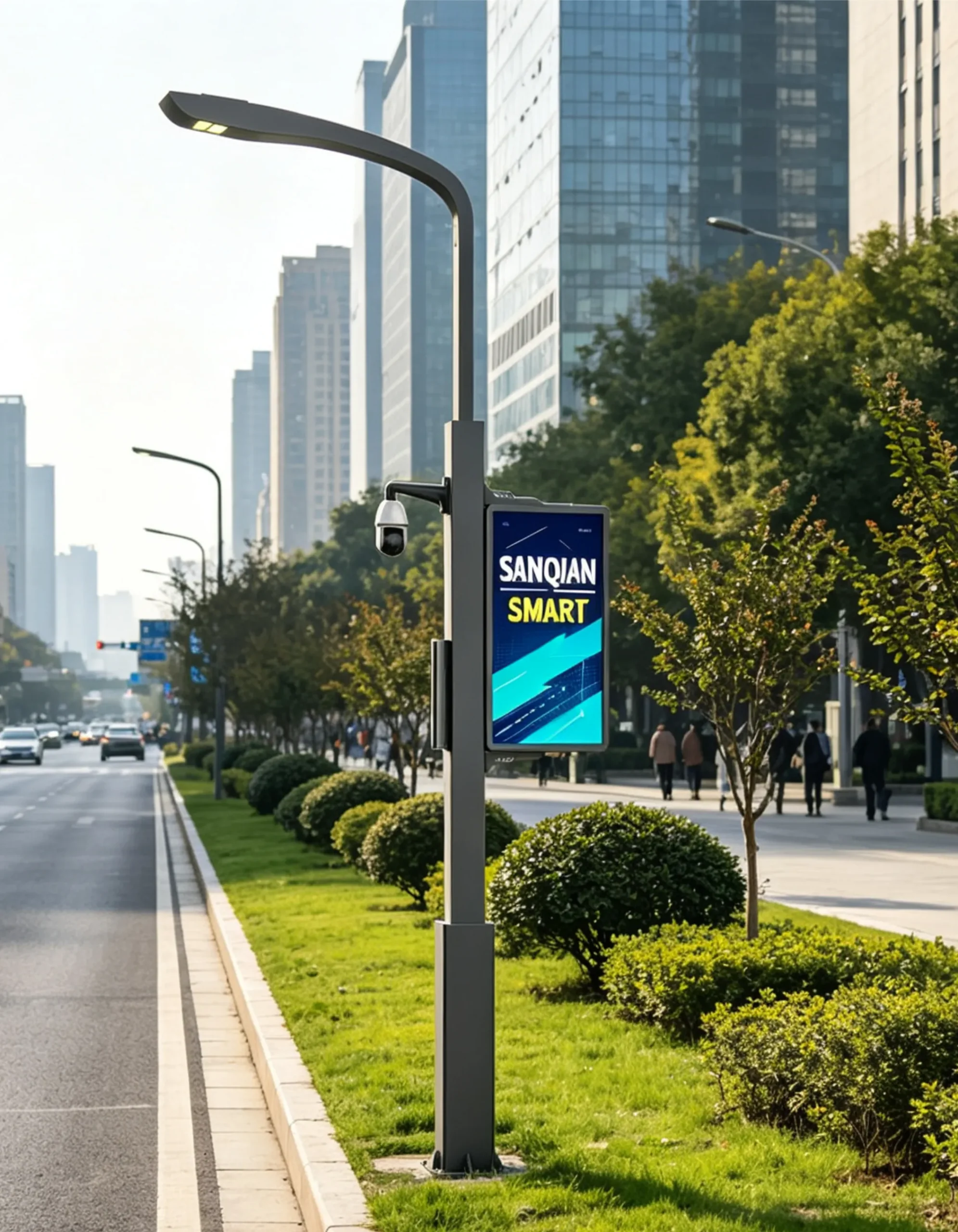
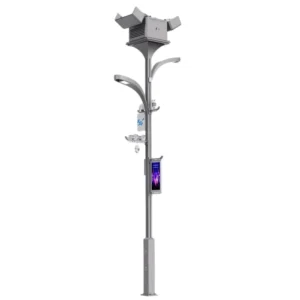
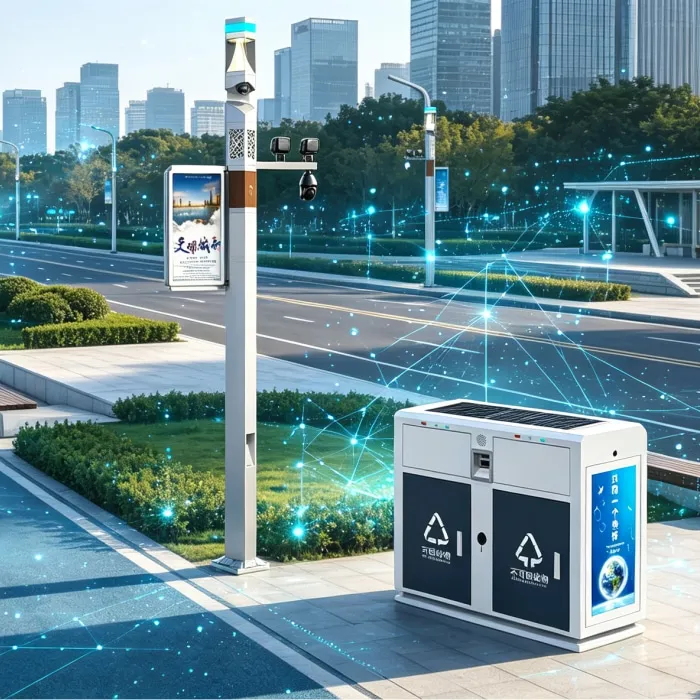
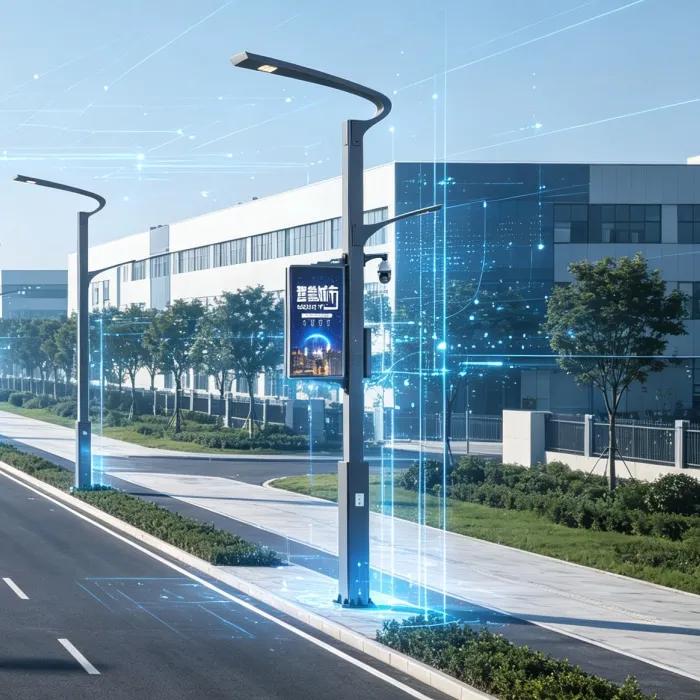
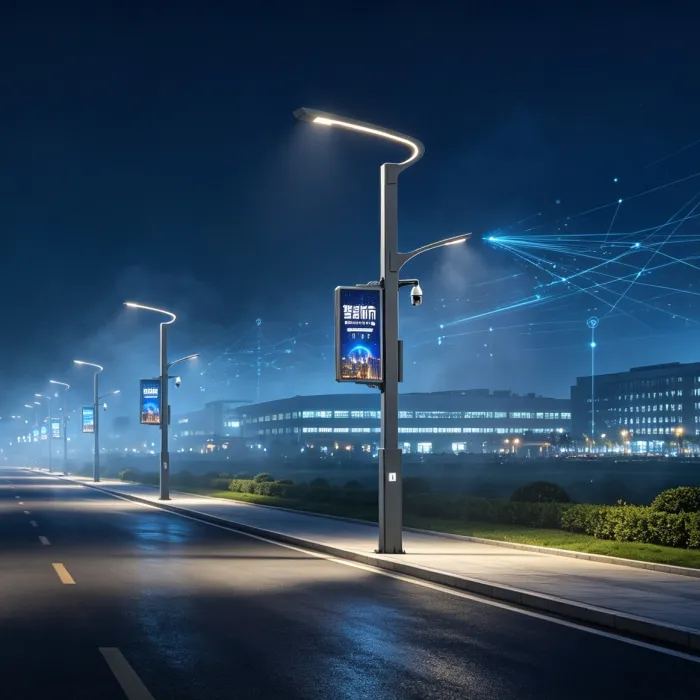
Poles are made from Q235 steel with hot-dip galvanizing and powder coating. Pole height is selected based on road width, typically 6m–9m, with wall thickness not less than 3mm. For coastal or corrosive environments, epoxy resin powder coating with additional corrosion protection can be added. Foundations use C25 concrete with embedded rebar cages, meeting wind resistance levels of not less than 12. The pole reserves IoT expansion interfaces so that future upgrades can add environmental monitoring, security surveillance, broadcasting speaker columns, and other equipment, enabling smooth evolution into “multi-functional smart poles.”
5. Smart Management Platform
The “Sanqian Smart Cloud Platform” is the management core of the entire solution, with the following key functions:
- Full lifecycle device management: assign a unique code to each street light, record installation location, device parameters, start/stop status, operating hours, and fault history, forming a digital device archive.
- Remote monitoring and single-light control: GIS maps visually display the distribution of street lights. Management can filter by town, administrative village, road, or overseas project sites. Administrators can remotely switch on/off, dim, and push strategies to individual lights, groups, or the entire coverage area.
- Smart dimming strategies: supports time-segment and scenario-based dimming. For example: full brightness in the first half of the night to ensure travel safety, then reduced to 40%–60% in the second half for energy savings. Low pedestrian-traffic segments can link with microwave radar sensing to achieve “lights on when people arrive, dim when people leave,” with an overall energy-saving rate of 40% or more.
- Automatic fault alarms: terminals collect photovoltaic voltage, battery voltage, charging current, and light source status in real time. Once photovoltaic anomalies, battery undervoltage, light source damage, communication dropouts, or other issues occur, the platform automatically generates alarm tickets and pushes them to maintenance personnel’s mobile apps. Fault localization accuracy can reach 95% or above.
- Energy consumption and power generation statistics: the platform automatically calculates daily energy generation, energy consumption, energy-saving rate, and cumulative carbon reduction, supporting energy-saving evaluations for towns and carbon asset accounting for overseas projects.
- Mobile maintenance app: maintenance staff use the “Sanqian Smart” mobile app to receive work orders, navigate to fault locations, scan to identify devices, upload repair photos, and close the loop on maintenance tasks, standardizing and making maintenance traceable. It supports multiple languages to help overseas local teams use it.
6. Power Supply, Distribution, and Energy Storage Design
Taking an example from a rural branch road in Zhejiang: use a 60W LED light source, with 10 hours of lighting per day, full power for the first 4 hours, then 50% power for the next 6 hours. The estimated daily energy consumption per light is:
- 4h × 60W + 6h × 30W = 420Wh
Considering system losses and redundancy for cloudy/rainy days, configure a battery capacity of 12.8V/50Ah, with stored energy of about 640Wh, sufficient for continuous normal lighting for 4 consecutive cloudy days. Choose a photovoltaic module of 100W; with an average effective peak sunshine of 3.5 hours/day, daily generation is about 350Wh. With MPPT controller efficiency of 95% or above, energy can be replenished during sunny weather, while energy balancing strategies ensure reliability across seasonal differences.
In mountainous areas with poor sunlight resources or multi-rain regions, photovoltaic power can be increased to 120W–150W, and battery capacity can be increased to 60Ah to ensure dependable winter or rainy-season operation. During system design, it is necessary to perform monthly energy-balance checks based on local meteorological data from the past decade to avoid “heavy configuration, light verification” leading to lights going out.
7. Construction Installation and Lightning Protection Grounding
Construction process includes:
- Foundation positioning and layout
- Excavation
- Embedded rebar cage installation
- Concrete pouring
- Pole assembly
- Photovoltaic module and luminaire installation
- Battery and controller wiring
- System commissioning
- Platform connection and acceptance
For lightning protection and grounding: a lightning rod can be installed at the top of the pole or the metal pole can be used as the air termination device. At the bottom, the pole is reliably connected to the grounding electrode via hot-dip galvanized flat steel. Ground resistance should be no more than 10Ω. The controller and battery compartment should be properly waterproof-sealed. Photovoltaic cables should use weather-resistant cables and be protected with conduits to prevent damage from rodents and aging. For coastal-area construction, special attention should be paid to corrosion protection for metal components and to foundation concrete mix ratios for salt-fog resistance.
8. Maintenance and Operations Assurance System
Establish a three-tier maintenance mechanism:
- County-level platform supervision
- Town-level local maintenance
- Village-level daily inspections
For overseas projects, adjust to a model of:
- Regional remote monitoring
- Local community electricians
County-level or regional management centers use the “Sanqian Smart Cloud Platform” to monitor equipment operating status across the full coverage area and supervise alarms that are not handled within the required time. Town maintenance teams or local partners stock spare parts per region. For ordinary faults, respond within 24 hours and repair within 72 hours. Village responsible persons or community electricians report anomalies through the app, forming a linked closed-loop process.
It is also recommended to clean photovoltaic module surfaces every six months and inspect batteries, controllers, and grounding resistance every year to ensure long-term stable system operation.
9. Benefit Analysis
Economic Benefits
Based on a scale of 1,000 street lights, solar street lights can save approximately 30%–50% compared with traditional grid-powered street lights in terms of cable installation, transformer capacity upgrades, and road excavation costs. There is no electricity cost during the operation period, only small maintenance expenses, so the overall lifecycle cost is significantly reduced. For off-grid areas, solar street lights can fully replace diesel generator lighting, saving fuel and maintenance costs.
Social Benefits
Improve nighttime road safety in rural areas, reduce traffic accidents, enhance conditions for residents’ nighttime travel and cultural activities, and support “safe countryside” and “beautiful countryside” initiatives. Overseas projects directly improve public safety and production conditions in remote islands and off-grid areas.
Environmental Benefits
Each street light can generate approximately 130–180 kWh per year on average, equivalent to reducing carbon dioxide emissions by about 100–140 kg. For 1,000 street lights, annual carbon reduction can reach 100–140 tons, providing measurable results for rural green low-carbon transformation or international carbon reduction goals.
10. Overseas Typical Application Case: Philippines Palawan Remote Island Rural Solar Street Light Project
To verify the solution’s suitability under different climates, geographies, and maintenance conditions, this section presents a typical overseas case of “Sanqian Smart” solar street lights deployed in a remote island village in Palawan Province, Philippines.
Project Background
A village in the southern part of an island in Palawan Province, Philippines, with a resident population of about 1,200. The village’s main road and fishing port connecting road total about 3.2 km. The island has no municipal grid connection; residents rely on diesel generators for electricity. Night-time road lighting has long been blank, creating safety risks for fish transport and nighttime travel. The island has approximately 4.2 sunshine hours per year on average. During the rainy season, continuous cloudy/rainy days can last 5–7 days. High temperature, high humidity, and severe salt-fog corrosion place extremely high demands on equipment weather resistance and endurance.
Configuration
The project uses 86 integrated “Sanqian Smart” solar street lights with the following core configuration:
- Photovoltaic modules: 120W monocrystalline silicon; mounting tilt optimized to 10° based on local latitude to balance rainy-season generation efficiency.
- Energy storage batteries: lithium iron phosphate 12.8V/60Ah to support normal lighting for 6 consecutive cloudy/rainy days; battery compartment uses fully sealed anti-salt-fog design.
- LED light source: 60W; color temperature 4000K; luminous efficacy 165 lm/W; fixture protection rating IP66; impact resistance IK09.
- Communication method: due to unstable 4G signals on the island, use LoRa self-organizing networking plus gateway satellite backhaul to ensure remote management of all devices.
- Intelligent control: built-in MPPT controller supports 100% brightness in the first half of the night and 40% brightness in the second half. The fishing port segment links with microwave radar sensing to achieve “boats arrive and lights turn on; people leave and lights dim.”
Implementation and Maintenance
From foundation construction to commissioning, the project took only 21 days. All pole foundations use salt-fog-resistant concrete mix designs, and metal parts receive hot-dip galvanizing plus epoxy resin powder coating for double corrosion protection. Maintenance relies on the “Sanqian Smart Cloud Platform,” coordinated between a remote team in Manila and local community electricians. The platform automatically pushes fault work orders; community electricians receive instructions via the mobile app and handle repairs on site. Spare parts are allocated from the regional warehouse. After 12 months of operation, the device online rate was 98.3%, average fault repair time was 36 hours, and battery capacity degradation was below 3%.
Project Benefits
The project ended the island’s history of no public lighting. Night-time fishing port operation efficiency improved by about 35%, and nighttime traffic accidents decreased by 70% or more. Each street light generated about 160 kWh annually on average; for 86 street lights, annual carbon reduction was about 11 tons. The project also saved the village collective about $12,000 USD per year in diesel generator-related lighting expenses. The project was listed by the Palawan provincial government as a “remote island green infrastructure demonstration site,” providing a replicable template for subsequent promotion to seven nearby islands.
Case Verification
The Philippines case validated the solution’s reliability under high temperature, high humidity, high salt-fog corrosion, and unstable off-grid public network conditions, especially the communication architecture of “LoRa self-organizing network + satellite backhaul,” the rainy-season endurance strategy using lithium iron phosphate batteries, and the effectiveness of the remote maintenance closed-loop mechanism. The case shows that the “Sanqian Smart” rural solar street light end-to-end solution is not only suitable for China’s rural revitalization scenarios, but also has the capability to be deployed in off-grid/weak-grid regions across Southeast Asia, South Asia, Africa, and Latin America.
11. Implementation Recommendations
It is recommended to adopt a strategy of “pilot first, then phased rollout.” Prioritize administrative villages with better baseline conditions and urgent resident needs. Use 3–6 months of operation to validate equipment reliability, platform functionality, and maintenance mechanisms. Then optimize the configuration based on pilot experience and replicate it across the entire town. For overseas projects, select typical remote islands or off-grid communities as demonstration sites. After establishing a regional maintenance center, scale up the deployment.
At the county level or for overseas project owners, it is also recommended to coordinate and develop solar street light management regulations to clarify asset ownership, maintenance responsibilities, and evaluation indicators, ensuring the project is built well, managed properly, and used for a long time. For cross-country projects, it is recommended to collaborate with local governments, NGOs, or community organizations to ensure sustainable operations.
Conclusion
With “Sanqian Smart” as the core, the rural solar street light end-to-end solution integrates high-quality hardware and smart management platforms. It not only solves the “whether there is lighting” problem, but also achieves long-term goals of “whether it is good, whether it saves, and whether it can be managed properly.” The solution supports both domestic and overseas scenarios: it serves China’s rural revitalization strategy and also provides green, smart, and sustainable infrastructure support for global off-grid/weak-grid regions, showcasing China’s smart lighting technology strength and social value.