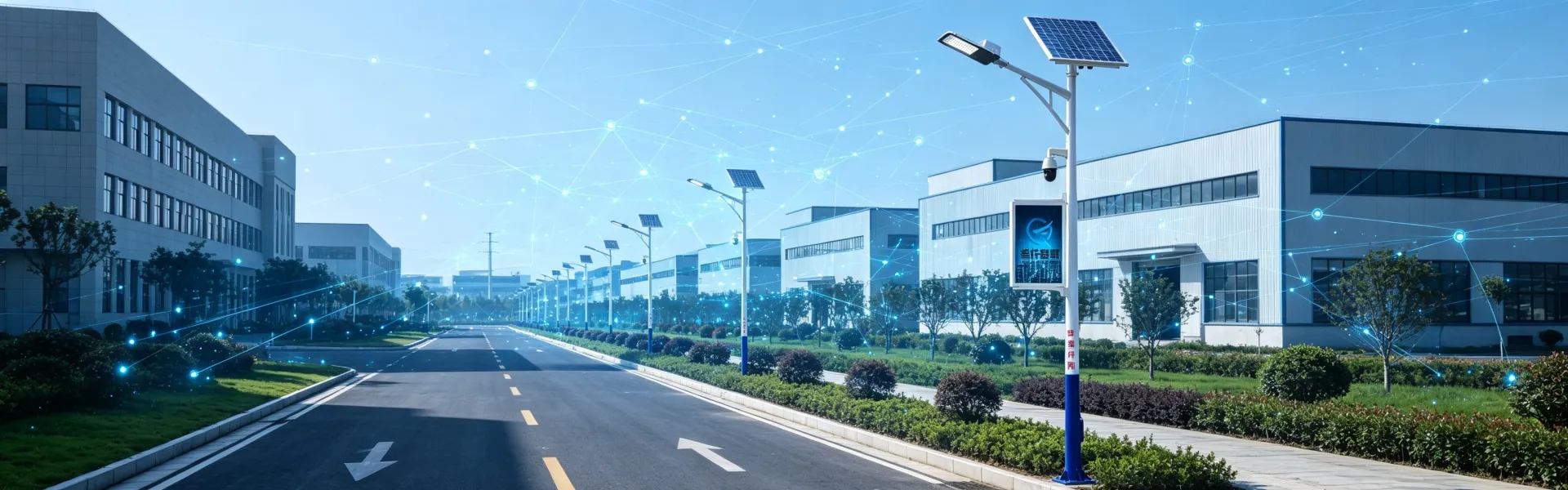
Smart Industrial Park Road System Solution
Integrated Application of Solar Street Lights and Renewable-Energy Smart Poles
1. Project Background and Needs Analysis
Modern industrial parks typically cover large areas, feature dense road networks, and experience frequent movement of vehicles and personnel around the clock. Traditional industrial-road infrastructure commonly faces the following challenges:
- High lighting energy consumption and inefficient management
- Inadequate illumination in some areas alongside excessive lighting in others
- Scattered security-monitoring points and blind spots along the perimeter and internal roads
- Limited capabilities for vehicle dispatching, personnel positioning, and environmental monitoring
- Uneven communications coverage throughout the industrial park
- Slow response to emergency incidents
At the same time, factories are highly sensitive to energy costs. How to reduce infrastructure energy consumption while ensuring production safety has become a key concern for industrial-park operators.
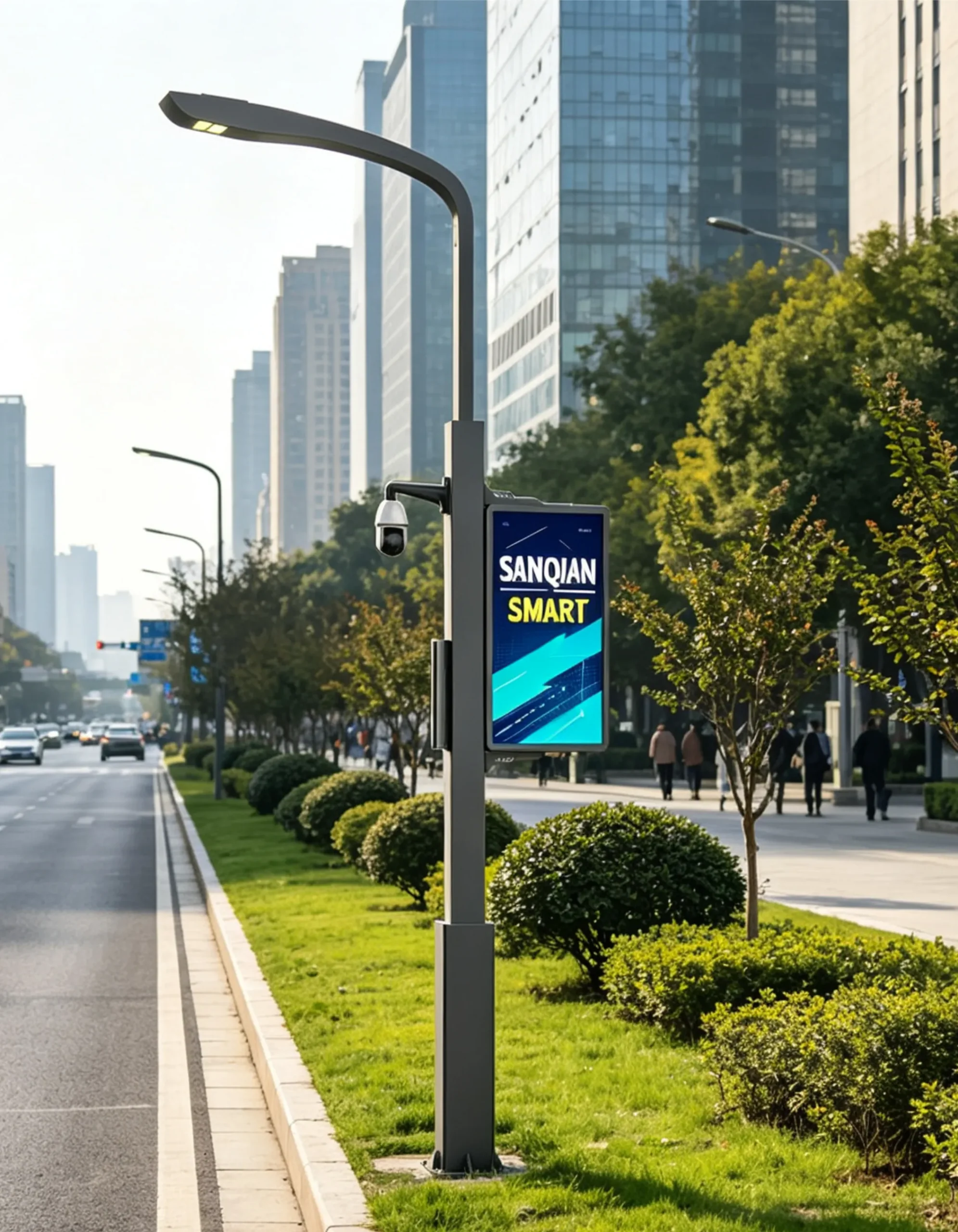
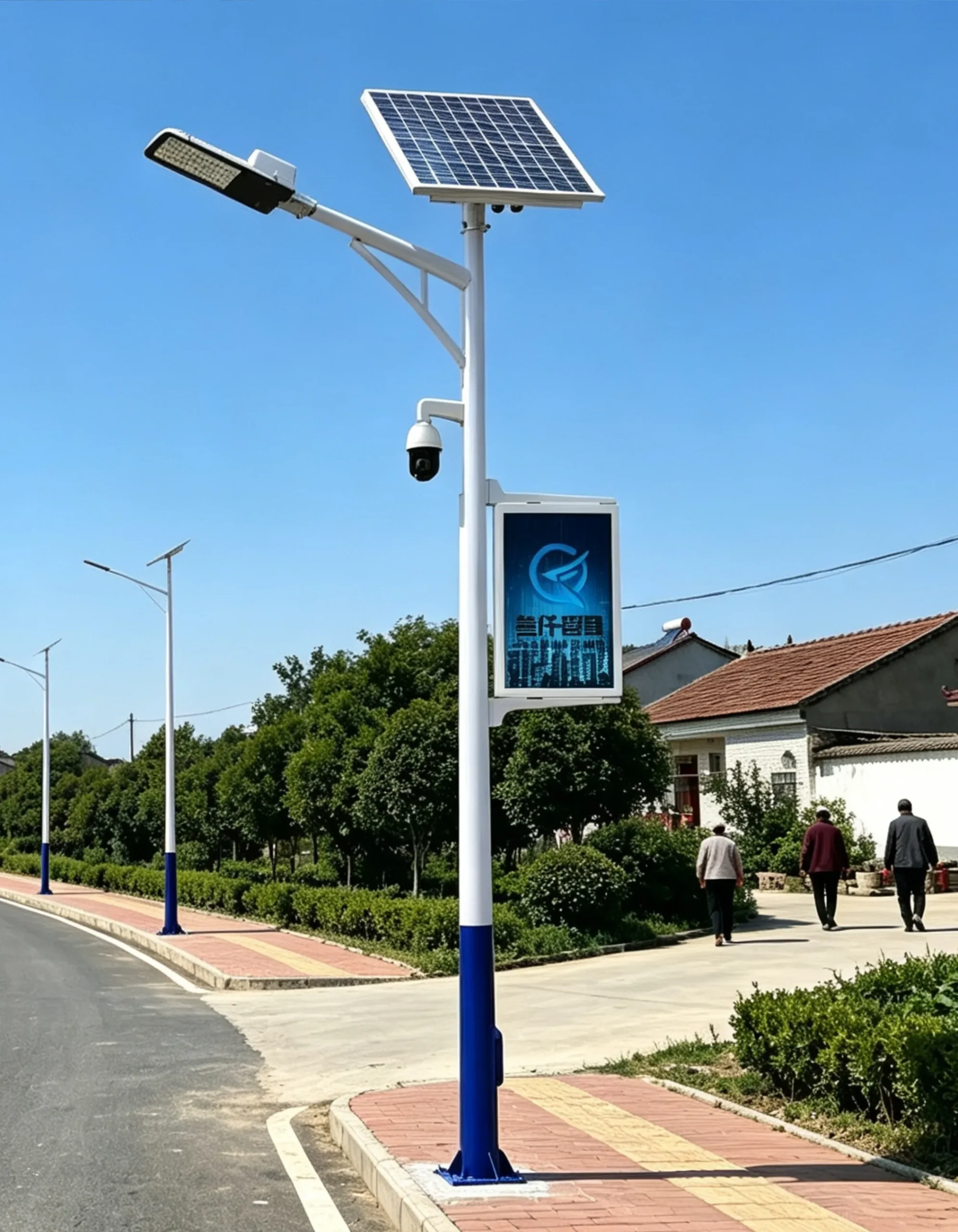
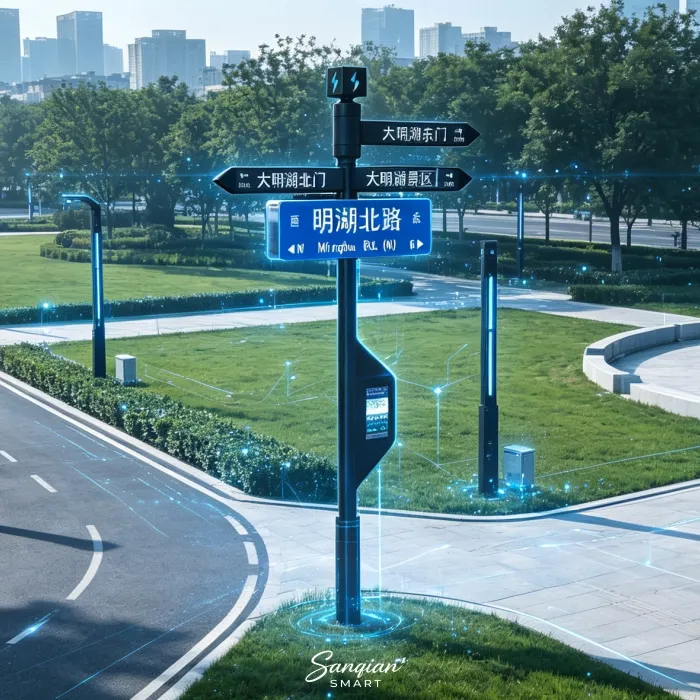
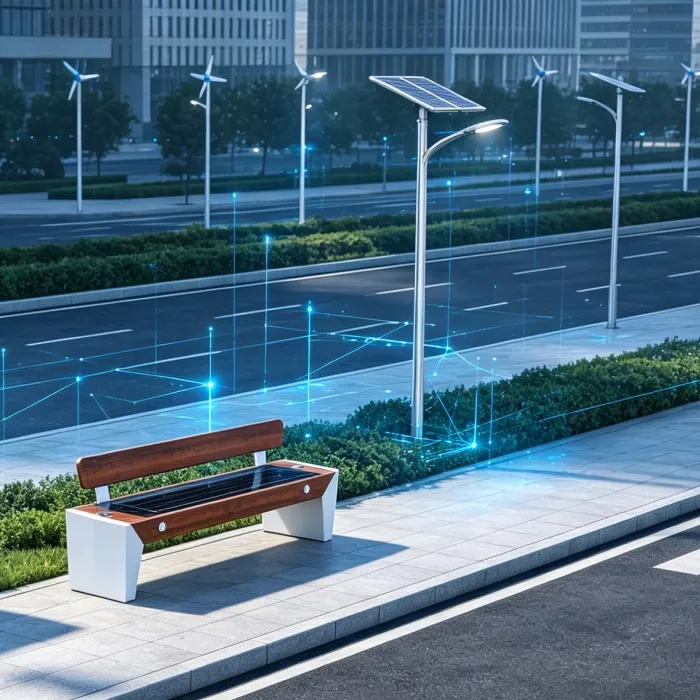
The combination of solar street lights and renewable-energy smart poles provides an effective pathway for upgrading industrial-road infrastructure. Solar street lights use clean energy for independent power supply, eliminating the need for cable installation and reducing electricity costs. Renewable-energy smart poles integrate video surveillance, environmental sensing, wireless communications, information displays, emergency alarms, vehicle charging, and other functions into the lighting infrastructure.
This enables “multiple functions on one pole and unified management through one network.”
Based on years of experience in smart poles and renewable-energy applications, Sanqian Smart has developed an integrated solution combining solar street lights and renewable-energy smart poles for industrial environments. The solution helps factories create a safe, green, efficient, and intelligent road environment throughout the industrial park.
2. Design Principles and Standards
The solution follows the principles of safety and reliability, economic practicality, green and low-carbon development, intelligent efficiency, and easy expansion.
The design primarily references the following standards:
- Standard for Urban Road Lighting Design (CJJ 45)
- General Technical Specification for Solar Photovoltaic Lighting Devices (GB/T 24460)
- Smart City, Smart Multi-Functional Pole, Specifications for Service Functions and Operation Management (GB/T 40994)
- Code for Design of Roads in Industrial Enterprise Areas (GB 50022)
The system is customized according to road classifications, vehicle traffic density, production-safety requirements, and local solar-resource conditions.
Key Design Indicators
- Average illuminance of at least 20 lx on primary industrial-park roads
- Average illuminance of at least 15 lx on secondary roads
- Average illuminance of at least 25 lx at intersections
- Illuminance uniformity of at least 0.4
- Solar street lights capable of operating normally for 3–5 consecutive cloudy or rainy days
- 100% video-monitoring coverage in key areas
- Platform device online rate of at least 99%
- Average fault-repair time of no more than 4 hours
3. Overall System Architecture
The system adopts a four-layer device–network–cloud–application architecture, integrating solar street lights and renewable-energy smart poles into one unified system.
Device and Sensing Layer
This layer consists of solar street lights and renewable-energy smart poles deployed along industrial-park roads.
Solar street lights provide basic illumination on standard road sections. Renewable-energy smart poles are installed at key locations, including:
- Main entrances and gates
- Primary-road intersections
- Warehouse entrances and exits
- Site perimeters
- Other security-sensitive areas
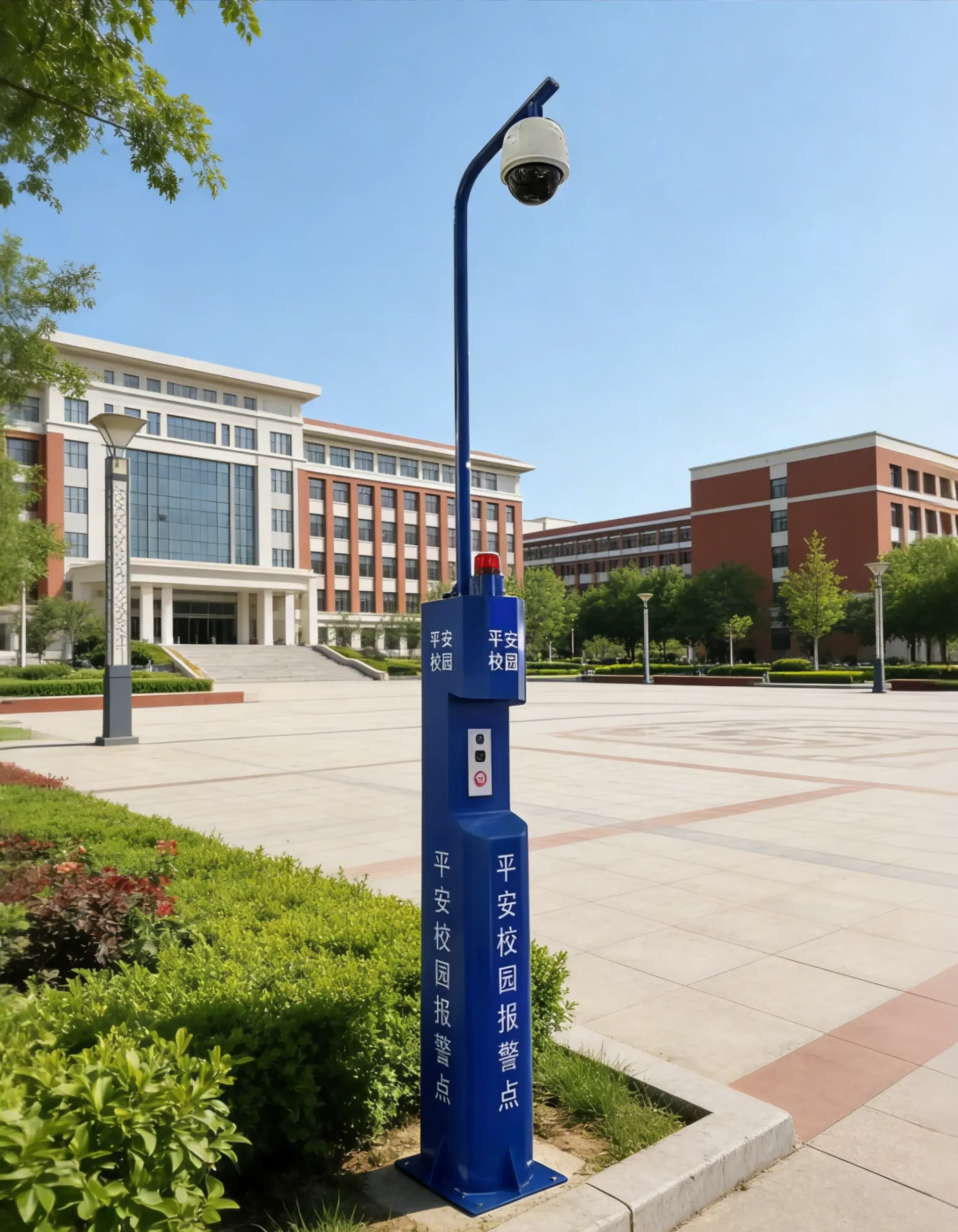
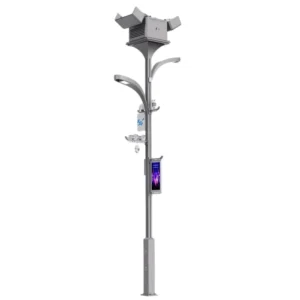
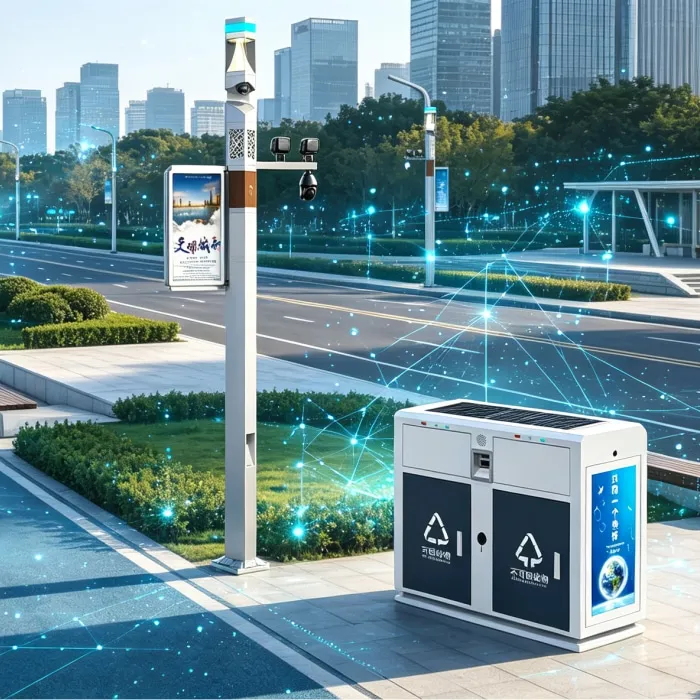
The smart poles can integrate intelligent lighting, video surveillance, one-button emergency alarms, public-address speakers, environmental sensors, WiFi or 5G small cells, LED information screens, and other modules.
All devices are connected to the management platform through unified controllers and communication modules.
Network Transmission Layer
Renewable-energy smart poles use fiber-to-pole or industrial Ethernet connections to ensure reliable transmission of high-bandwidth services such as video surveillance.
Depending on their distribution, solar street lights can use LoRa, NB-IoT, or 4G Cat.1 wireless networking.
Existing factory network resources can be utilized to support secure network isolation and data exchange.
Platform Layer
The system is managed through the Sanqian Smart Cloud Platform or the locally deployed Sanqian Smart Industrial Smart Road Management Platform.
The platform provides:
- Device access
- Data aggregation
- Rules-engine management
- Alarm handling
- Energy-consumption analysis
- GIS-based visualization
- Coordinated-control strategies
It also supports integration with factory MES, security systems, energy-management systems, and other existing platforms.
Application Layer
Web-based and mobile applications are provided for different departments and roles, including:
- Security departments
- Equipment departments
- Logistics departments
- Production-dispatch centers
Role-based permission management, unified dashboard monitoring, and coordinated incident handling enable efficient cross-department collaboration.
4. Core Equipment Selection and Configuration
4.1 Solar Street Lights, Basic Lighting Units
Photovoltaic Modules
High-efficiency monocrystalline silicon modules are used, with a conversion efficiency of at least 21%.
The power rating is selected according to the lighting source and local solar conditions:
- 80–120 W for secondary roads
- 150–200 W for primary roads
The mounting angle is optimized according to the latitude of the industrial park, with consideration given to winter energy generation.
Energy-Storage Batteries
Lithium iron phosphate batteries are used, with sufficient capacity to support 3–5 consecutive cloudy or rainy days.
Common configurations range from 12.8 V/40 Ah to 12.8 V/80 Ah.
The battery compartment features anti-theft, waterproof, and dust-resistant protection, with an operating temperature range of -20°C to 60°C.
LED Light Source
The LED lighting system provides:
- Luminous efficacy of at least 160 lm/W
- 5000K cool white light or 4000K neutral white light
- Protection rating of IP65 or above
- Dimming from 0% to 100%
Smart Controller
The controller integrates:
- MPPT charging management
- Multi-period dimming
- Energy metering
- Automatic fault diagnosis
- Wireless communications
It supports remote monitoring and control through the Sanqian Smart platform.
4.2 Renewable-Energy Smart Poles, Key-Location Units
Renewable-energy smart poles upgrade the basic solar street-lighting system into multifunctional intelligent infrastructure.
The poles are generally 8–12 meters high and made of high-strength steel with hot-dip galvanization and powder coating. Multiple mounting interfaces are reserved for future expansion.
In addition to intelligent lighting, the poles can integrate the following modules:
Video Surveillance
Network cameras with a resolution of at least 4 megapixels support:
- Infrared night vision
- Motion detection
- License-plate recognition
- Perimeter-intrusion detection
The cameras can be integrated with the factory’s security platform.
One-Button Emergency Alarm and Public Address
An emergency-alarm box is installed on the pole and supports two-way voice communication.
Integrated IP speakers support zone-based broadcasting and emergency voice announcements.
Environmental Monitoring
The system collects data on:
- Temperature
- Humidity
- PM2.5
- PM10
- Noise
- Volatile organic compounds (VOCs)
- Carbon monoxide (CO)
- Other relevant environmental parameters
This supports occupational health, environmental safety, and EHS management.
Wireless Coverage
WiFi 6 access points or 5G small cells can be integrated to eliminate mobile-communication blind spots throughout the industrial park.
The network can support inspection terminals, automated guided vehicles (AGVs), and other connected equipment.
Information Display Screens
LED or LCD screens can publish:
- Safety reminders
- Production notices
- Weather alerts
- Visitor guidance
- Emergency information
- Other operational messages
Renewable-Energy Charging, Optional
At parking lots or loading and unloading areas, smart poles can integrate AC charging stations for electric forklifts, patrol vehicles, and employees’ electric vehicles.
4.3 Smart Pole Structures and Foundations
All poles are made of Q235 steel and treated with hot-dip galvanization and powder coating.
The poles are designed to withstand wind forces of at least Beaufort force 12.
Foundations are constructed with C30 concrete and embedded anchor cages.
Because heavy industrial vehicles may generate significant vibration, the foundations of solar street lights and smart poles should be designed with consideration for heavy vehicle traffic. Reinforced foundations and vibration-reduction measures can be adopted where necessary.
5. Smart Management Platform Functions
The Sanqian Smart Industrial Smart Road Management Platform serves as the central management system for the entire solution.
Lighting Strategy and Energy Management
Based on factory shift schedules, sunrise and sunset times, and vehicle and pedestrian density, the platform automatically executes time-based lighting strategies.
For example:
- Full-power lighting during shift-change periods
- Lighting reduced to 30% during low-traffic nighttime periods
- Sensor-based activation when vehicles or personnel are detected
The platform records the power generation, electricity consumption, and energy-saving rate of each light and generates energy reports to support the factory’s carbon-accounting activities.
Video and Security Coordination
Smart-pole cameras transmit live video to the platform.
The system supports:
- Electronic-map positioning
- Video patrols
- Perimeter-intrusion alerts
- Coordinated security responses
When an emergency alarm is triggered, the platform automatically retrieves footage from multiple nearby cameras, allowing security personnel to assess the situation and issue remote voice announcements.
Environmental and Safety Monitoring
The platform displays environmental heat maps for the industrial park in real time.
Automatic alerts are generated when noise levels or hazardous-gas concentrations exceed configured thresholds, supporting the factory’s EHS management.
Full-Life-Cycle Device Management
Each light and smart pole is assigned a unique identification code.
The platform records:
- Operating status
- Fault history
- Maintenance records
- Service history
- Asset information
This creates a digital asset register for the entire lighting and smart-pole system.
Maintenance Work Orders
When a fault is detected, the platform automatically generates a work order and sends it to maintenance personnel through the mobile application.
The system supports:
- QR-code repair requests
- Photo uploads
- Work-order tracking
- Closed-loop completion
This helps maintain a high equipment availability rate.
6. Example of Power Distribution and Energy-Storage Design
The following example is based on the primary road of an automotive-parts factory.
- Road width: 12 meters
- LED power per light: 100 W
- Daily operating time: 11 hours
- Full-power operation: 5 hours
- 50% power operation: 6 hours
The daily energy consumption of each light is calculated as follows:
5 h × 100 W + 6 h × 50 W = 800 Wh
A 12.8 V/80 Ah lithium iron phosphate battery provides approximately 1024 Wh of stored energy, which can support normal lighting for four consecutive cloudy or rainy days.
A 200 W photovoltaic module is selected. Based on an average of four effective peak-sunlight hours per day, the estimated daily power generation is approximately 800 Wh.
Combined with an MPPT controller efficiency of more than 95%, the system can achieve a balanced energy supply.
In regions with insufficient solar resources or frequent rainfall, the photovoltaic capacity can be increased to approximately 250 W to ensure reliable operation during winter.
7. Typical Application Scenarios
Primary Roads and Logistics Routes
Solar street lights are used as the primary lighting solution, while renewable-energy smart poles are installed at key intersections.
The smart poles integrate video surveillance, public address, and information displays to support safe vehicle movement and publish real-time logistics information.
Warehousing and Loading Areas
Smart poles are deployed at key locations and equipped with high-definition cameras and license-plate recognition.
The system monitors loading and unloading operations, while charging stations provide power for electric forklifts and transport vehicles.
Industrial-Park Perimeters and Remote Areas
Solar street lights provide basic illumination, while smart poles integrate perimeter-intrusion detection and infrared cameras.
This helps eliminate security blind spots. High-brightness lighting can be activated automatically at night when activity is detected.
Employee Parking Lots and Residential Areas
Smart poles integrate WiFi, environmental monitoring, and information-display screens.
They can provide electric-vehicle charging and publish shuttle-bus schedules, cafeteria menus, safety notices, and other employee-service information.
8. Benefits Analysis
Economic Benefits
Solar street lights eliminate the need for cable installation and reduce electricity costs.
Smart poles reduce the need for multiple independent poles and separate system construction.
For a project comprising approximately 500 solar street lights and 50 smart poles, the total construction cost can be reduced by approximately 25%–35% compared with a conventional solution combining grid-powered street lights, independent security systems, and independent public-address systems.
During operation, the system can save hundreds of thousands of yuan in annual electricity and maintenance costs.
Management Benefits
Unified platform management integrates lighting, security, environmental monitoring, and information publishing.
This reduces cross-department coordination costs and shortens emergency-response times from minutes to seconds.
Safety Benefits
Comprehensive video coverage is provided in key areas.
The coordinated operation of perimeter alarms and lighting significantly improves nighttime safety and helps reduce the risk of theft, unauthorized access, and industrial accidents.
Environmental Benefits
Each solar street light can generate approximately 200–300 kWh of electricity per year on average.
This is equivalent to reducing carbon dioxide emissions by approximately 160–240 kg per unit.
For 500 solar street lights, the annual carbon reduction can reach approximately 80–120 metric tons, supporting green manufacturing and ESG initiatives.
9. Implementation Recommendations
A strategy of overall planning and phased implementation by zone is recommended.
Phase One
Priority should be given to:
- Factory entrances
- Primary roads
- Warehousing areas
- Site perimeters
- Other security-sensitive areas
The first phase should deploy solar street lights and smart poles at key locations, establish the management platform, and complete integration with existing security and energy-management systems.
Phase Two
The system can then be extended to:
- Secondary roads
- Parking lots
- Employee residential areas
- Other operational zones
This will enable full coverage of the industrial park.
Operation and Maintenance
It is recommended to establish a management structure led by the Equipment Department, coordinated with the Security Department, and supported by a professional maintenance team.
Remote platform inspections should be combined with on-site quarterly maintenance to ensure long-term, stable system operation.
10. Conclusion
Industrial-park roads are the arteries of production and an essential line of defense for operational safety.
The Sanqian Smart integrated solution combining solar street lights and renewable-energy smart poles uses clean-energy lighting as its foundation and smart poles as intelligent infrastructure nodes.
Through a unified management platform, it enables coordinated lighting, security, environmental monitoring, communications, information publishing, and other functions.
The solution helps factories build safe, green, efficient, and intelligent road infrastructure. It not only reduces operating costs but also supports the digital and low-carbon transformation of industrial parks, making it an ideal infrastructure-upgrade solution for the smart-manufacturing era.